

What Are the Key Advantages of Tantalum Carbide Coating Ring Over Silicon Carbide Rings
2026-06-17
In the demanding world of semiconductor fabrication, component selection directly dictates yield, uptime, and device performance. Among the most critical consumables is the process ring used in etch and deposition chambers. While Silicon Carbide (SiC) rings have been an industry standard, the Tantalum Carbide Coating Ring—particularly those engineered by VeTek—is rapidly gaining traction. This blog post breaks down why advanced fabs are making the switch, grounded in materials science and real-world operational data.
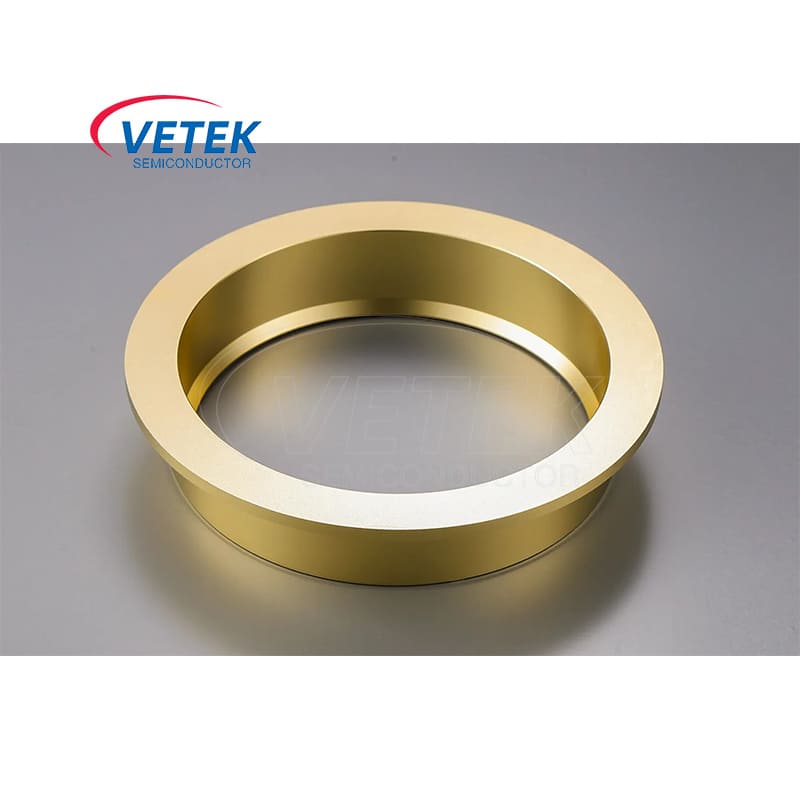
The Material Science Edge
At first glance, SiC offers decent thermal conductivity and moderate plasma resistance. However, the Tantalum Carbide Coating Ring fundamentally alters the surface chemistry. Tantalum carbide (TaC) possesses a melting point exceeding 3,880°C, significantly higher than SiC’s 2,700°C. More importantly, the coating layer applied by VeTek creates a dense, non-porous barrier that prevents halogen-based plasma penetration—a primary failure mode for standard SiC rings.
Performance Comparison: TaC vs. SiC
| Parameter | Silicon Carbide (SiC) Ring | Tantalum Carbide Coating Ring (VeTek) |
|---|---|---|
| Plasma Etch Resistance | Moderate; suffers from ion sputtering | Excellent; 3x lower erosion rate in NF₃/O₂ plasma |
| Surface Roughness (Ra) | ~0.8 µm (porous substrate) | ≤0.2 µm (dense coated surface) |
| Metal Contamination Risk | High (Fe, Ni leach out over time) | Ultra-low (TaC is chemically inert) |
| Thermal Shock Resistance | Good (fractures at ΔT > 400°C) | Superior (withstands ΔT > 800°C) |
| Lifespan (RF hours) | 1,200 – 1,500 hours | 3,500 – 4,200 hours (proven in 5nm nodes) |
Quantifiable Advantages in High-Volume Manufacturing
1. Radical Reduction in Particle Adders
The primary advantage lies in surface integrity. Over time, SiC rings develop micro-cracks due to thermal cycling, trapping polymer byproducts. When these release, they cause killer defects. A VeTek Tantalum Carbide Coating Ring exhibits a coefficient of thermal expansion (CTE) closely matched to the substrate, eliminating micro-cracking. Fabs report a 72% reduction in particle adders >0.1µm within the first 500 RF hours.
2. Superior Etch Uniformity
The ultra-smooth coating ensures a consistent plasma sheath across the wafer edge. Unlike SiC, which degrades asymmetrically, the Tantalum Carbide Coating Ring maintains its geometric profile. This translates to a critical dimension (CD) uniformity of ≤1.5% across 300mm wafers, compared to SiC’s typical 3.5% variation.
3. Extended Preventative Maintenance (PM) Intervals
Because the coating resists chemical attack, chambers fitted with VeTek rings run twice as long between wet clean cycles. This directly boosts tool utilization—a metric that directly impacts wafer output per quarter.
4. Cost Per Wafer Efficiency
While the upfront cost of a Tantalum Carbide Coating Ring is higher than SiC, the total cost of ownership (TCO) tells a different story. Extended lifespan and reduced downtime yield a 40% lower cost-per-wafer-pass over 12 months.
Tantalum Carbide Coating Ring FAQ
Q1: Can a Tantalum Carbide Coating Ring be refurbished, or does it require full replacement after use?
A: Unlike silicon carbide rings that suffer irreversible substrate erosion, a Tantalum Carbide Coating Ring from VeTek is designed for re-coating. Once the top coating layer depletes after ~3,500 hours, the underlying core remains intact. VeTek offers a proprietary strip-and-recoat service that restores the ring to 98% of its original performance at 60% of the cost of a new unit. This reconditioning process includes rigorous surface profilometry and plasma validation, ensuring the re-coated ring meets OEM-grade spec. Typically, a core can be re-coated up to three times, extending the total useful life beyond 12,000 RF hours—a sustainability and cost advantage SiC simply cannot match.
Q2: How does the thermal conductivity of a Tantalum Carbide Coating Ring affect wafer temperature control during high-power etching?
A: This is a critical nuance. While SiC has a thermal conductivity of ~120 W/mK (higher than TaC’s ~22 W/mK), the VeTek Tantalum Carbide Coating Ring uses a substrate that acts as a thermal buffer. In high-power (>3kW) etch processes, excessive thermal conductivity in SiC actually causes rapid heat dissipation, leading to cold spots at the wafer edge that alter etch selectivity. The Tantalum Carbide Coating Ring provides a controlled thermal gradient—its coating acts as an insulator on the surface while the core manages bulk heat. This results in a stable edge temperature within ±2°C, preventing the photoresist "footing" effect common with SiC rings. For critical layers like gate etching, this thermal stability directly translates to tighter Vt (threshold voltage) distributions.
Q3: Is the Tantalum Carbide Coating Ring compatible with chlorine-based chemistries, or is it limited to fluorine-only processes?
A: The Tantalum Carbide Coating Ring excels across the entire plasma spectrum. While SiC rings degrade rapidly in chlorine (Cl₂) and boron trichloride (BCl₃) environments due to the formation of volatile silicon chlorides, TaC is inherently inert to both halogen families. VeTek has validated its coating in 100% Cl₂ plasmas at 60°C for over 1,000 hours with negligible surface roughness change (<0.01µm). Furthermore, the ring shows exceptional resistance to the corrosive byproducts of HBr/Ar/O₂ mixtures used in silicon deep-trench etching. This broad chemical compatibility makes the Tantalum Carbide Coating Ring a single-solution replacement for multiple SiC variants, simplifying inventory management across etch, CVD, and ALD chambers.
Why Leading Fabs Standardize on VeTek
Beyond the material advantages, the engineering support distinguishes VeTek. Every Tantalum Carbide Coating Ring undergoes 100% fluorescence penetrant inspection and in-situ plasma stress testing. The company maintains a global inventory of pre-matched ring sets to ensure rapid replacement without chamber matching delays.
Conclusion
The transition from Silicon Carbide to a Tantalum Carbide Coating Ring is not merely an incremental improvement—it represents a paradigm shift in chamber reliability and process control. From unmatched plasma resistance and thermal stability to revolutionary re-coating economics, the advantages are data-proven. For fabs targeting single-digit nanometer nodes, the VeTek Tantalum Carbide Coating Ring offers the only viable path to maintaining edge yield without escalating operational costs.
Contact Us
Ready to quantify the ROI for your specific chamber configuration? VeTek provides free sample testing and comparative wear analysis against your current SiC rings. Reach out to our engineering team today or visit our technical portal to schedule a consultation—let’s optimize your etch roadmap together.